
This is an actual photo of Budapest, not an artist’s idealized rendering. It looks like it’s made of daydreams and spun sugar.
The Kid is on vacation this week—in Budapest.
In a phone call home, we discussed goulash.

Our version of goulash.
In our family, goulash is a stew-like dish made with hamburger, roasted garlic, mushrooms, tomato, and pasta of some sort. It’s filling, tasty, reheats like a dream, and with a dollop of sour cream is practically perfect comfort food. In other areas of the US, various iterations of this dish are known as American chop suey, beefaroni, and curiously, Johnny Marzetti.

A plate of the real thing, from a restaurant in Budapest.
The Kid informed me that our goulash has nothing in common with true Hungarian goulash (which I knew) and it’s the national dish, served mainly on special occasions (which I didn’t know).
But the US/Hungarian dinner dichotomy got me to thinking.
What is wrong with us as a nation that we take a perfectly good ethnic dish and pervert it into something the citizens of the dish’s birth country wouldn’t recognize it if a pan of it was dumped over their heads?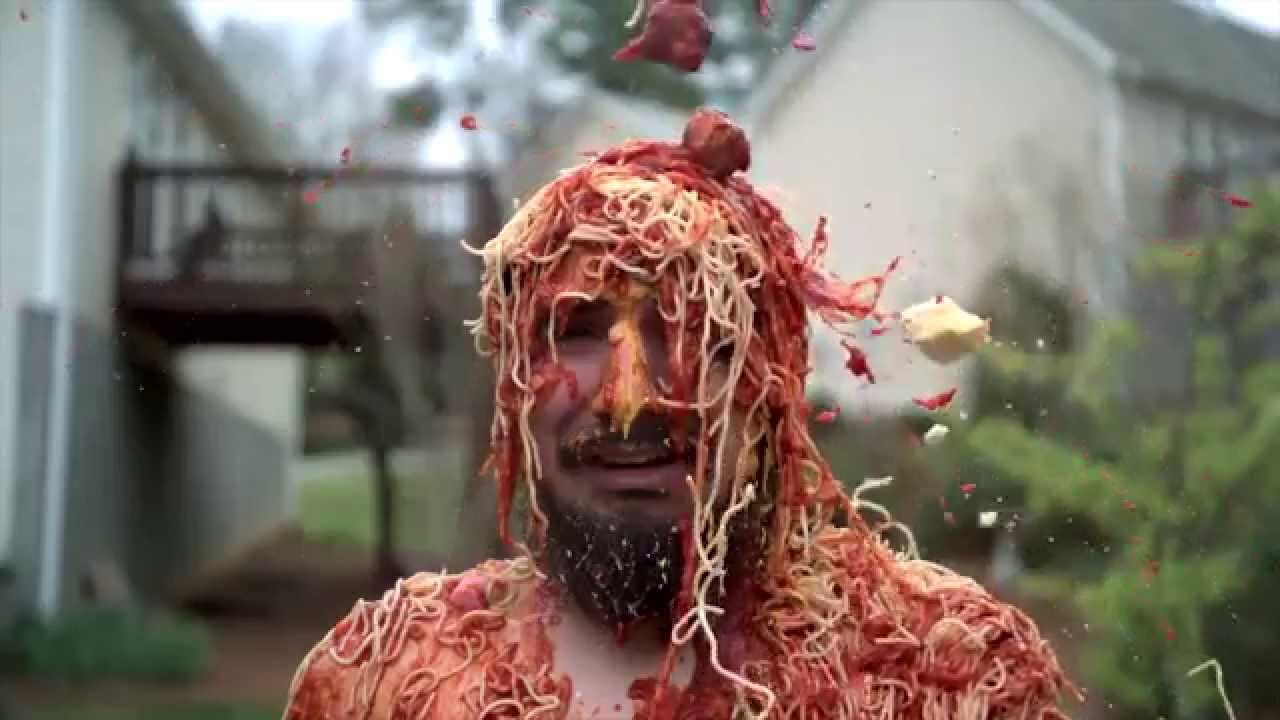 And goulash is the tippiest tip top of the culinary iceberg. If a national dish can be changed so profoundly that the only thing left in common with the original is the moniker, we, the people have probably done it.
Take, for example, spaghetti and meatballs. It is true that Italians eat both spaghetti and meatballs, but never together, and certainly not like we do. Meatballs are neither the size of cantaloupes, nor served on pasta. And they sure as heck never break spaghetti in half before it goes into the pot. Serving or consuming cheese from a green can in Italy will get you serious prison time, where they never, ever serve spaghetti and meatballs.

Authentic street tacos of carnitas, white onion, and cilantro. Like a dog, I could eat these until they kill me. But what a way to go.
Mexican food in general, and tacos in particular. Nowhere in Mexico does anyone serve shredded lettuce and cheddar cheese on a traditional taco. Or ground beef. Or seasoning from a glossy envelop manufactured in a Scottish company in Maryland. Taco shells are not even a thing. And those u-shaped, bland, crispy shells from a cardboard box would just make a Mexican abuela (grandmother) cry and pray for our very souls.

Why ya gotta make Gramma cry?
In elementary school they made something they called chicken chow mein. It was a glue-y, stew-y dish of chicken and celery served over rice. A handful of noodle-shaped cracker things were thrown over the top for crunch. I, and many of my classmates loved it. We were little kids though, so what did we know from international cuisine?

Chicken chow mein ala Central Elementary school.
But the only thing that lunch tray ambrosia truly had in common with the authentic Chinese dish was the chicken.

This is the real thing. Check out the crispy noodles.
It’s not even a rice dish. Traditional chow mein is made with egg noodles. They are fried so they’re crispy and crunchy in spots. This, I imagine are where those canned crunchy noodle things came in.

This product alone made him a hero to generations of schoolchildren and stoners everywhere.
The one man that arguably put more chow mein in more American bellies than any other single person is Jeno Paulucci, a second-generation Italian who founded the canned Chinese food company, Chun King, in the 1940s. He seasoned the food with Italian flavors, in an effort to make the taste more familiar to the European palate. This mania to morph traditional recipes has almost become a national joke, a kind of twisted point of pride. At a bicentennial dinner attended by Paulucci, President Gerald Ford summed it up by asking, “What could be more American than a business built on a good Italian recipe for chop suey?”

Ladies and Gentlemen, President Ford.
Many of these Americanized, sanitized dishes are favorites from our childhood. So, eat them to your heart’s content. But would it kill you to at least sample the authentic food that inspired them?

C’mon, you know you wanna…
Thanks for your time.
 Mom’s from New Jersey and my dad’s from Pittsburgh. Jersey was also represented in her sister, Aunt Polly, and her brother and my Godfather, Uncle Sammy, and his wife Candy.
 My brother was born in Mobile, and his wife and daughters are NC born and bred. Petey’s from a long line of Tar heels, and The Kid is 100% pure Durham.
  But, it was the food which starkly illustrated the North/South divide.
 First up was ziti. Ziti is the ham biscuit of the northern states. Whenever there is any occurrence that necessitates the bringing of food; funerals, sickness, babies, there are pans of ziti. Every well-stocked freezer has a pan or two; ready to go in the oven, or out the door.
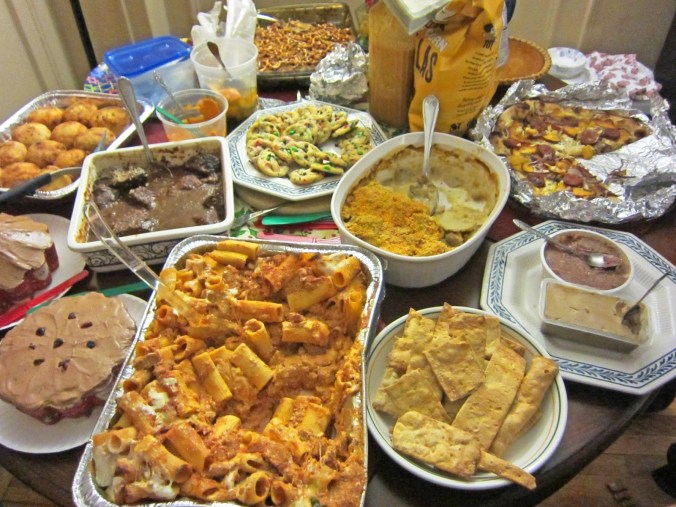 Although ziti is also a pasta shape the type of noodle in a pan of ziti is cook’s choice. Both my aunt and mother favor rigatoni. But I’ve made it with everything from actual ziti, to my fave, cavatappi; a long corkscrew-shaped, ridged tube.
 Candy’s last dish was simply very thinly sliced kielbasa slow-cooked with sauerkraut in a crock pot. It was amazing by itself, but it would be a revelation heaped onto a warm pretzel bun and slathered with mustard.
 Because at that point, we all surrendered—to flavor.
 Preheat oven to 350. Slice 7 or 8 zucchini length-wise. Using a spoon scoop out seeds and pulp, and place pulp in a skillet along with ½ diced yellow onion and a spoonful of dehydrated garlic. Cook in a little butter until the liquid is mostly cooked out and veggies are golden-brown. Stir in enough Italian-style breadcrumbs to stiffen the stuffing. Spoon stuffing into zucchini. Bake uncovered about 40 minutes, until the zucchini is tender, and the stuffing has browned. Serves 10-12.
 bull city mom