Fry baby, fry

McDonald’s is being sued.

They’ve recently begun selling mozzarella sticks.  It seems that instead of piping hot, breaded planks of cheese, numerous patrons have been presented with hollow cylinders of sadness—no cheese.

The corporate explanation: “In these instances, we believe the cheese melted out during the baking process in our kitchens and shouldn’t have been served,”

My guess is that at some point the sticks may have had a very brief sojourn in an oven; either in the facility that prepares food to be shipped out to local restaurants, or in the store itself.  But make no mistake, those things also spent some time in a bubbling oil Jacuzzi.  Or should have, anyway.

First the bad news about frying.

My personal pet peeve is that frying’s messy.  Oil is greasy, and the bubbling fat produces tiny little droplets that float through the air and coat everything (including people) in the kitchen.  I always shower after frying and as soon as the hot water hits me I smell like the corn dog stand at the state fair.  Yuck.

It’s not the healthiest method of cooking.  No matter how you do it, fried food will absorb some fats.  It just will.  This can be mitigated though.  Use unsaturated plant-based fats.  Animal fats are the culinary equivalent of Bacardi 151.  This is the kind of thing that should only be indulged in once or twice a year, if ever.

He likes duck fat fries too…

Frying is really east to screw up.  When Petey and I were first married, I decided to make fries from scratch, and fry them up.  Unfortunately I’d never asked anyone how to do this.  So, I put a big pot on the burner, poured in about $10 worth of oil (a ton of money back then), and turned on the burner.

After about five minutes, I dumped in all of my hand cut fries.  There was nothing.  Those puppies sunk into that oil with barely a ripple, let alone the all-important bubbling and sizzling sounds.

I was flabbergasted when 15 minutes later I pulled out potatoes which were colorless, limp, and as greasy as a seventies disco owner, only no hairy chest and gold medallion peeking out from a half-buttoned polyester shirt.  They were inedible, and I wasted a bucket of food.

This is what my poor fries looked like.

It was literally years before I tried deep-frying again.  By that time, I understood the science of cooking in general, and frying specifically much better.

Like hot air, boiling water, fire, and steam, that bubbling oil is merely the medium to transmit heat into the food.  Hot oil is just about the most efficient method.  Unlike water which boils at 212, the correct temp for frying is 350 degrees.  That is 65% higher.  Unlike baking or grilling, oil completely surrounds the food, which cooks it quicker, and more evenly.

Here’s what happens when you fry.

When the food enters the oil, the surface moisture is turned into steam; thus the bubbles.  As it cooks the heat is transferred into the interior, cooking off more moisture.  If the temp is correct, and the food not too dense, when the exterior is golden, the interior is cooked through.  Also all the surface water is gone, giving you that addictive crispy mouth-feel.

If you listen closely, you can hear angels singing.

All oil has something called a smoke point.  It is the temp at which the oil begins to break down.  It will smoke, the food will taste funny, and dangerous, carcinogenic compounds will be formed.  This food will basically be funky tasting poison.  Olive oil has a very low smoke point, so bad for frying, peanut oil high; so good.

Temp is not only important at the start; you also want to control something called recovery time.  That is the time it takes for the oil to come back up to temp after you put food into the oil.  So, you don’t want to put too much in at one time—this will lower the temp so much that it may never heat back up, and you will end up with greasy, soggy, thoroughly unpleasant fried food.

And if you’re going to turn your kitchen into an oil slick, and risk ruination of your heart and waistline, at least do it right.

Thanks for your time.

Tender at the home

The Kid has been living here at the house for the past few months, until a suitable abode could be procured which didn’t necessitate a roommate (it’s an only child thing).A cute little place, not far from us has been found, and our little occupant is in the process of moving in.  And while The Kid will come home for family dinners from time to time, this week is really the last week in which we will sit down for regular suppers.

So, when I was figuring out what nights The Kid would be home from work at supper time, and what I would make, my child had a meal request.

My buttermilk chicken tenders.It’s a family favorite: strips of very juicy white meat, with the tang of buttermilk, and a seriously crispy coating.  But juicy and crispy from one piece of chicken can be extremely problematic.  So, what to do?  And how to do it?

My answer was science.

I was looking for a coating that was insanely crispy, thin and delicate.  I desired golden, salty fairy wings.

Fat-free buttermilk would give me flavor.  It’s viscous enough to cling so that I wouldn’t need any eggs.  Plus, and most importantly, it’s chock full of acid.  Which I needed for the other part of my dredge.

chic tenders

Number two was self-rising flour.  This is flour fortified with salt and baking powder.  Double-acting baking powder has, like the name implies, two opportunities to rise.  One is at room temperature, when it comes into contact with acid.  The second is in the presence of heat.  It can impart a salty, bitter flavor, but the buttermilk tang, salt, and pepper will entirely negate that.

For 1 ½ pounds of tenders, I use about 2 cups of fat-free buttermilk, seasoned, and poured into a shallow dish large enough to easily fit the chicken.  I use three or four cups of self-rising, also seasoned.  It may seem like a lot of flour, but I promise you don’t want to run out halfway through cooking, and be stuck scrambling with nothing left but those weird lumps made when buttermilk drips into the flour.  The breading system is three-stage; flour, then buttermilk, and then back once more into the flour before finally frying.

I also highly recommend using gloves.  And a second person, to actually fry each piece while you’re coating, makes the whole ordeal almost simple.

The procedure is also pretty specific.  Unlike the way I usually like to cook, the tenders cannot be done in advance.  To get that ultra-crispiness you have to bread the chicken immediately before frying.  Otherwise that first, acid-based rise will disipate and you won’t get the full ethereal crust.

And the frying portion of the program is kinda picky, too.I cook the chicky in my 10-inch cast iron pan.  I pour in vegetable oil about 1/3 of the way up the side and heat it to 350 degrees.  When placed in the pan (don’t crowd them—no more than four at a time), the oil should not be deep enough to cover them.  When the bottom is golden flip and cook the other side.  If you oil temperature stays near 350, by the time the tenders are golden all over, the chicken is cooked through, but still crazy juicy.  Perfect.I serve them with ranch dressing and honey mustard for dipping.  Our side is always a green salad, to make ourselves feel just a bit better for all the gorging that takes place.

Thanks for your time.

That’s all pork, folks

I feel like I wasted thirty years of my life.

I have a headache.

All those days I drove myself crazy trying to figure out, for one more meal, what protein to cook.  Beef, chicken, fish, eggs, and pork; they’re my usual guest stars.

With pork it was chops, Boston butt, ham, and happily, bacon.

A couple of years ago, I was in the supermarket, checking out the meat that had been marked down, like I always do.  You never know what you’ll find.  That day they had pork tenderloins for about three bucks, down from their usual 6-7 dollars.Pork tenderloin comes from the full loin.  It’s about eight inches long and a couple inches across.  It weighs between 12 and 24 ounces.  The meat is very tender, if it’s cooked correctly.  It’s very easy to overcook and end up with jerky.  But it’s also very easy to cook right—you just need one simple tool (more on that later).

The flavor is extremely mild, so it’s easy for it to come out bland and flavorless.  But again, that’s easy to remedy.  It also gives you an opportunity for lots of fun.

I usually impart flavor in a three-step process.

1.)Dry marinade-I freeze the tenderloin solid.  Then I choose an herb/spice blend, and liberally rub it over the entire surface.  For one piece of meat I’ll use at least a tablespoon.  I then put it into a zip-top bag and let it thaw in the fridge overnight.

2.)Paint-After searing the meat in a smoking-hot pan, I choose a some type of spread and brush it all over.

3.)Crust-Once the tenderloin is covered in something wet, I roll it in something chunky or crusty.  Then I finish it in the oven.

The most difficult, but also the most exciting part of the process is choosing the components for your pork.

The other night I tried a new combination for Petey and me.  It came out beautiful and delicious.  The spice comes from the Middle East, the dressing and pecans from the Southern US.

 Globetrotting tenderloin

pecan pork loin

One pork tenderloin (approximately 1 pound)

1 tablespoon za’atar; a spice mixture containing thyme, sumac, sesame seeds and other herbs, depending on who makes it.  I purchase mine pre-mixed from Spice Bazaar at 4125 Durham-Chapel Hill Blvd, in Durham.

1 teaspoon salt

½ teaspoon cracked black pepper

2 tablespoons vegetable oil, divided

2 tablespoons Anne’s “The One Sauce”; this is a rich honey mustard dressing.  If you can’t find it, use your favorite honey mustard, or make your own.

¾ cup raw pecans, finely chopped

Preheat oven to 450 degrees.

In a small bowl, mix za’atar, salt and pepper.  Rub the seasoning all over the frozen pork.  Place in bag, refrigerate, and allow to thaw fully.

Put a large frying pan on the stove, and heat until it’s almost smoking.  Pour in 1 tablespoon oil.  Add tenderloin and turning with tongs, sear all over.  Remove from pan, and place on a plate.

Brush a layer of dressing all over the pork.  Roll the meat into the pecans, completely coating it.

Pour the second tablespoon of oil into a baking dish.  Add pork.  Either using a probe thermometer or an instant-read, cook until the internal temp is 145 degrees (for medium).  If you overcook this, it will be dry and tough.  A thermometer is the best tool to easily prevent that.

Once it comes up to temp (about 15-20 minutes), remove from oven and let rest, lightly covered for five minutes or so.

Slice and serve.  Serves 2-3.

There are less than 250 calories in a large serving of tenderloin.  It’s also a lean protein, chockfull of vitamin B6, thiamin, niacin, and riboflavin.  There are healthy amounts of omega (3 & 6) fatty acids, too.

We had ours with scalloped potatoes and some peas and carrots.  It would also be nice served with buttered mushroom rice, and roasted asparagus.  I think it could make a very tasty sandwich on ciabatta, with crispy greens, and another schmear of honey mustard.

I’m glad I finally discovered the wondrousness of pork tenderloin.  It just breaks my heart to think of all the delicious meals I’ve missed out on.

Thanks for your time.

The five people you’ll meet in the kitchen (and the one you should be)

No matter what, everybody’s gotta eat.

I don’t care who you are, if you want to keep walking around on this rock, you need to eat.  No exceptions.

But everybody’s different and the kitchen is where these differences come into stark relief.

I have identified the five main types you may run into:

1.)There’s the cook I call “Persnickety Pierre”.This guy can do no cooking unless he is working from a recipe that is practically Byzantine in its complexity.  Every step must be related in intricate, painstaking direction.  Food that should take 30 minutes takes an hour and a half because Pierre can’t keep himself from repeatedly opening the oven to check on the proceedings.

His kitchen is so sparkling clean you have to wear sunglasses in it.  There are enough cleaning chemicals in the cabinets to hold chemistry class.  He has a diverse wardrobe of Hazmat suits.

If he cooks for you, the food probably won’t taste terribly good, but you can be confident of never contracting a food-borne illness at his table.

2.)At the polar-opposite is Lady Laissez-faire.This self-taught, self-proclaimed chef cooks constantly.  There are only two problems.

She can’t be bothered to actually read through a recipe.  Her favorite expression is, “Don’t worry; I got the gist of it.”

No dish is ever truly finished, she never knows how many it will serve, and doesn’t have a clue how to save her leftovers, of which she always has many.

Her other characteristic is a lackadaisical attitude toward substitutions.  Honey for maple syrup is perfectly acceptable.  But Lady L has run amuck.  She will blithely sub out cayenne pepper for paprika, fish sticks for fresh shrimp, and once, in a pinch, gummy bears for mushrooms.  It may rarely be edible, but it’s always original.

3.) And there’s “Can-do Man”.

This is what happens when you consume too many chemicals.

If it doesn’t come in a can, box or bag, he’s not interested.  Kits are where it’s at.  Our guy eats so many preservatives in his food that he will be dead ten years before he starts to decompose.


4.) There is also the cook I call, “Finger-on-the-pulse-diet chef”.This miss eats no gluten, carbs, animal fat, refined sugar, or dairy.  If there’s a new diet out there, she has done just enough research on it to be misinformed.  She generously imparts her knowledge with everyone, whether they want it or not.  Priscilla firmly believes that bad diets are the root of all society’s ills.

High cholesterol?  White food’s off limits.

Insomnia?  Go paleo.

Color blind?  Eat capers and licorice, together.

Flat feet? No food with the letter “R” in it.

The funny thing is, our girl has acid reflux, eczema, and could stand to lose 15 pounds.

5.)Our final cook is called “The Frat Boy”.There are two kitchen tools upon which Biff relies.  One’s his microwave; he can heat up Spaghetti-o’s and pop popcorn like a champ.  The other is his telephone.  He’s on a first-name basis with every take-out place in town.  He built a tool shed from pizza boxes.  His fridge contains only beer and duck sauce.  He named his dog “Raman”.

And lastly I hope, you.

Know your recipes, and keep your kitchen clean.  But don’t be too uptight, and feel free to get creative.  Short cuts are ok if used sparingly.  Learn something about nutrition and try to eat right.  And once in a while, take the night off and order in something yummy and a little naughty. Above all, keep cooking, and have fun.

Thanks for your time.

Let the chocolate chips fall where they may

Each year by this point in January, I’m getting mighty tired of all the commercials for gym memberships and advertisements for nutritional supplements.Instead of working out and eating steamed fish, it all makes me want to lie immobile on the couch and eat milk duds.

I might feel that way, but the truth is I do still try to move around some, and eat reasonably well.  But just because I consume fresh fruit and veg and whole grains doesn’t mean I never eat anything just because it tastes good.

And I really do sleep better when I have a few bites of something sweet before bed.  So last Friday night, when, because of the snow and ice I wasn’t sure if we’d have electricity in the morning, I made a pan of brownies.I started with a mix, which I usually do.  But this batch was the best batch I’ve turned out in years.  The Kid and I loved them, which isn’t very surprising.  But the shocker was that Petey really liked them as well.  Not being a self-indulgent choco-phile, he doesn’t usually eat my brownies anymore.  He says they’re “too much” (but where chocolate is concerned, please explain to me what is too much).

I think these were better received because I didn’t go overboard on any one ingredient.  I added espresso, but just enough to heighten the flavor, not give you a coffee-favored punch in the nose.  There were chocolates, but not a surfeit of any one type.  They were salted, but only enough to give each bite the tiniest little salty crunch.

As a woman I can testify to the fact that some days only a satisfying chocolate treat can keep me from committing mayhem on loved ones and strangers alike.  These mahogany-colored confections, accompanied with copious amounts of red wine, would be a huge hit when shared by a group of women.

Best.Book.Club.Night.Ever.Boxed up and tied with a pretty red silk ribbon, then handed over for Valentine’s Day would ensure extra credit (I actually started to write ‘brownie points’ here) for the next 364 days.
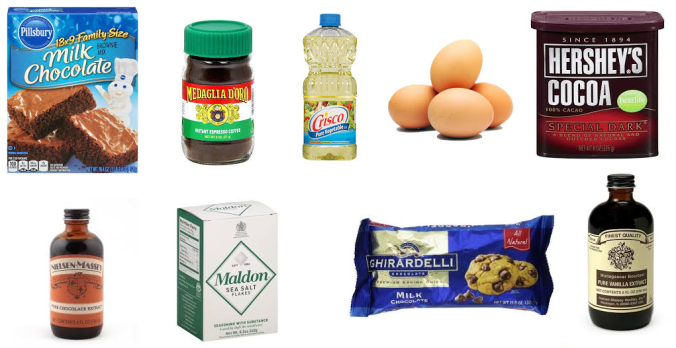
I call these “Golf Brownies” because there are 4 (fore, get it?) kinds of chocolate in them.  Unfortunately, Petey doesn’t appreciate the humor of the moniker.  But bless his heart, he’s got lots of other very good qualities.

*Recipe note-For chocolate extract, I use Nielsen-Massey.  It’s available online and at local fancy cooking stores.  Maldon salt, found at the same kind of places, and lately some mega-marts, is a very large, flaky finishing salt for sprinkling.

Golf brownies

golf brownies

1 13X9 family size package Pillsbury milk chocolate brownie mix

1 teaspoon instant espresso powder dissolved in ¼ cup very hot water

2/3 cup vegetable oil

2 eggs

2 tablespoons Hershey Special Dark cocoa powder

1 teaspoon pure chocolate flavor

½ teaspoon vanilla extract

½ teaspoon kosher salt

1-11.5 ounce bag Ghirardelli milk chocolate chips

1-2 teaspoons Maldon salt

Preheat oven to 350 degrees.  Put all the ingredients except Maldon salt into large bowl.  Mix well.  Pour into 9X13 pan sprayed with cooking spray.  Liberally sprinkle Maldon salt on batter and bake.

Bake 13 minutes, spin pan 180 degrees and bake for 14 more.

Remove to cooling rack and allow to cool completely.  This recipe makes 2 dozen reasonably-sized pieces, or 6 extra-large PMS pieces.

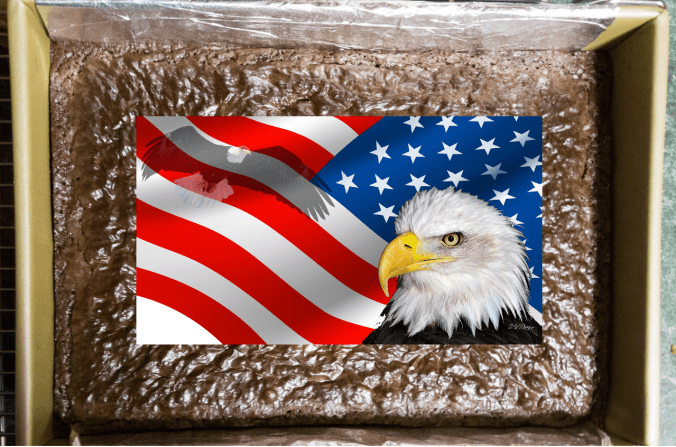
Truly, brownie mix is one of the greatest benefits of living in this great country of ours.

usa brownies

Mmmmm…America…

You can have them ready for the oven in minutes, and they will obediently bend to your will, mood, and pantry.

For texture, try adding broken pretzels, nuts, or Oreo pieces.  Before baking, drop dollops of dulce de leche, peanut butter, or Nutella on  top.  Then using a sharp knife, swirl it enough to produce a marble-like effect.  Go a little sideways, and mix in crispy bacon, cracked pink peppercorns, or diced, candied ginger.

My point is that sometimes, like when it’s day three of being trapped in in the house with your entire family by snowmageddan, there’s nothing in this word that will do but a freshly baked brownie.                                                       Thanks for your time.

A rye smile

After inhabiting this planet for more than half a century, I have ceased to be embarrassed by the fact that I have the type of sweet tooth that if I let myself, would make it perfectly feasible for me to eat an entire box of Dolly Madison vanilla zingers.Honestly, I’m not exaggerating.  One of my very favorite foods is birthday cake.  And when I say cake, I mean cake only in the sense that it is the scaffolding for mounds of delicious, delicious frosting.

But I am also a bit of a paradox inside a contradiction stuffed in a jelly donut.

I can’t abide a grain of sugar in my iced tea, I order my lattes half sweet, and I like my soft drinks lots more fizzy than syrupy.

Did you notice she has monkeys on her dress?

So, I guess those bi-polar taste buds are the reason why I really enjoy this new treat I discovered last week.

The Kid and I spent the day in Raleigh.  We visited the NC Museum of Art to check out the Da Vinci and Escher shows, and headed over to our favorite capitol city bakery, Boulted (614 W South St, Raleigh).  My child was Jonesing for some of their seeded levain; a crusty, sour loaf perfect for lashings of cultured European butter.  I snagged a bagel-like bialy for breakfast, then spied something called rye shortbread.

We added it to our order.

As soon as we got back to the car, I took a bite of my shortbread.  I was totally expecting a salty, rye/caraway-flavored buttery cracker.  What I got was something entirely different.  It was a lightly sweetened, pecan-studded cookie with the acidic kick of rye.

Once I got over the surprise, I took another bite.  And found that I really enjoyed it.  It would be the perfect thing to accompany a really thick, rich cup of hot chocolate.

I did a little research, and a little experimenting, and came up with this recipe.

Rye-Pecan shortbread

rye shortbread

1½ cups rye flour

½ cup finely chopped toasted pecans

½ teaspoon kosher salt

¼ teaspoon baking powder

1 cup butter (softened)

¼ cup Granulated Sugar

3 tablespoons honey

Whisk together flour, pecans, salt and baking powder.  Set aside.

Cream the butter, sugar and honey until just incorporated.

Add the sifted dry ingredients to the butter mixture. Mix on low until it all comes together, but no longer (there’s gluten in rye flour, and you don’t want it to develop).

Roll the dough to ½-inch thick (if the dough is too soft to roll, shape into a disk or rectangle, wrap in plastic and chill until firm). After rolling, cut into bars, circles or desired shape. Cover and chill until hard; 2 hours or overnight.

Preheat oven to 350°F. Line a baking sheet with parchment paper.

Place cookies on prepared pan and sprinkle with sugar and more pecans, if desired. Dock the center of each cookie with a fork.  Bake until edges are lightly browned, about 20 minutes.

Cool and store, wrapped, at room temperature for up to 1 week.

This recipe makes approximately 20 cookies.

I’m not saying I would regularly pick this cookie over a heavily decorated cupcake, or a Krispy Kreme donut fresh from its honey glazed shower, but this shortbread gets my full confectionary seal of approval.  This new treat definitely has a spot in my rotation.

Now, if you’ll excuse me, I suddenly feel the urgent need to see if there is a flashing “Hot” sign anywhere in the vicinity.

Thanks for your time.

Nutritional bang for your buck

I adore breakfast food.  All of it: eggs, carbs dripping with butter and syrup, processed meats, everything.breakyBut, I absolutely cannot face the thought of bellying up to the breakfast bar the moment I roll out of bed.  It makes me queasy to even think of food then.  I think my stomach wakes up much slower than the rest of me.

So often my breakfast is almost at lunch time.

In the spirit of total honesty, I have to confess though that some days I fall far short of nutritional excellence and my meal is sorely lacking.  But frozen yogurt and lattes both have calcium.  Right?  Right?

It’s an inconvenient bit of truth, but even though two foods might, on paper, have the same amount of calories, in reality they don’t.Think about it.  Say you drink a 200 hundred calorie latte.  Although you get a tiny bump of calcium, it really is nutritionally empty and your body can digest it in mere minutes.

But say that instead you have 200 calories of oatmeal made with skim milk, and studded with dried fruit and nuts.

Just off the top your body has to work much harder and longer to digest this meal.  It also contains complex carbohydrates, fiber, and protein.  It fuels your body, and you will feel full for hours.  Full enough to walk right past that vending machine.So, this week I have some suggestions for quick meals that will fill you up, be better for you, will be much more satisfying, and make you feel much more virtuous.

Quick, homemade meals:

Hot cereal- Oatmeal, Cream of Wheat, grits, or even something like hot Grape Nuts are all terrific.  You can make them sweet with additions like honey or maple syrup, then stir in nuts, seeds, and fresh or dried fruit.  Also don’t be afraid to add things like cocoa powder, vanilla and spices.

But hot cereal is also very tasty when you go in a savory direction.  Try topping it with things like caramelized onions, sautéed mushrooms, and sundried tomatoes.  Nuts work well here too.  Then you can perk it up even more with hot sauce, cheese, horseradish, and herbs.  Maybe top it off with a poached egg.Toasts and sandwiches:

First, get rid of that spongy white bread-like substance that they sell in plastic bags.  Then get to know multigrain.  The labels can be confusing, and manufacturers can be deceptive, so either buy it at a bakery so that you can talk to the baker and learn how it was made, or purchase products that say “100% whole grain”.

You can fill that healthy platform with anything that tickles your fancy.  Smashed avocado, scrambled egg, peanut butter and sliced apple, even a grilled cheese that you stuffed with some tomato and fresh greens.  How about tuna mixed with hummus?

Smoothies: Buy various frozen fruits, leafy greens, and maybe some low fat Greek yogurt. Throw different combos into your blender until you find a recipe that you like.

Store-bought, but pretty healthy:

Tacos:  Gosh, I love the fact that tacos can be on this list.

Yes, tacos can be fatty, nutritional nightmares.  But done right, they can be downright good for you.  Leave off the cheese and sour cream—dress with salsas only.  Then fill with grilled or roasted meat, and raw veggies.  I wouldn’t go for more than two for lunch though, no matter how tasty they may be.

At the deli:  Clear soups and lightly dressed salads are both good choices.

In addition, sandwiches can be a wise choice as long as it’s on whole-grain bread or wraps.  Grilled meat is better than cold cuts.  Raw veggies can be eaten with impunity.  And everybody knows that regular mayo isn’t great.  But be careful with mustard, too.  Some are chock full of sodium and/or fat.

The biggest thing to remember when eating out is to watch that serving size.  At most places, a single serving is enough for two—meals or people.  Either take home half in a doggy-bag or think about possibly ordering the child’s size.So, become mindful of what you put inside your body.  That way, you can have that second cookie before bed.

Thanks for your time.


The opposite of money

Give a man a ribeye and you can eat in twenty minutes; teach a man to cook a pot roast and dinner will be ready in six to seven hours.Last week I talked about cooking with ingredients that are scarce and expensive.

This week is all about the ingredient that money can’t buy—time.

Salad bars and prepped produce in grocery stores can be a convenient time saver.  But you will absolutely pay for it.  Usually 3-4 times the price of its un-messed-with cousins.“Peasant” food; tough cuts of meat, slow cooking beans, humble, tough grains all take time to prepare.  On the other hand, choice cuts of meat and tender, young vegetables only suffer if they stay on the heat too long.
Frozen dinners and pre-cooked meals from your local store’s hot bars more expensive by a factor or five.  Like my mom says, “Boy, they sure saw you coming”.  It may be nice to quickly grab ready-to-eat dinner, and sometimes necessary, but doing it night after night will triple or even quadruple your monthly food budget.

It’s all about the time.

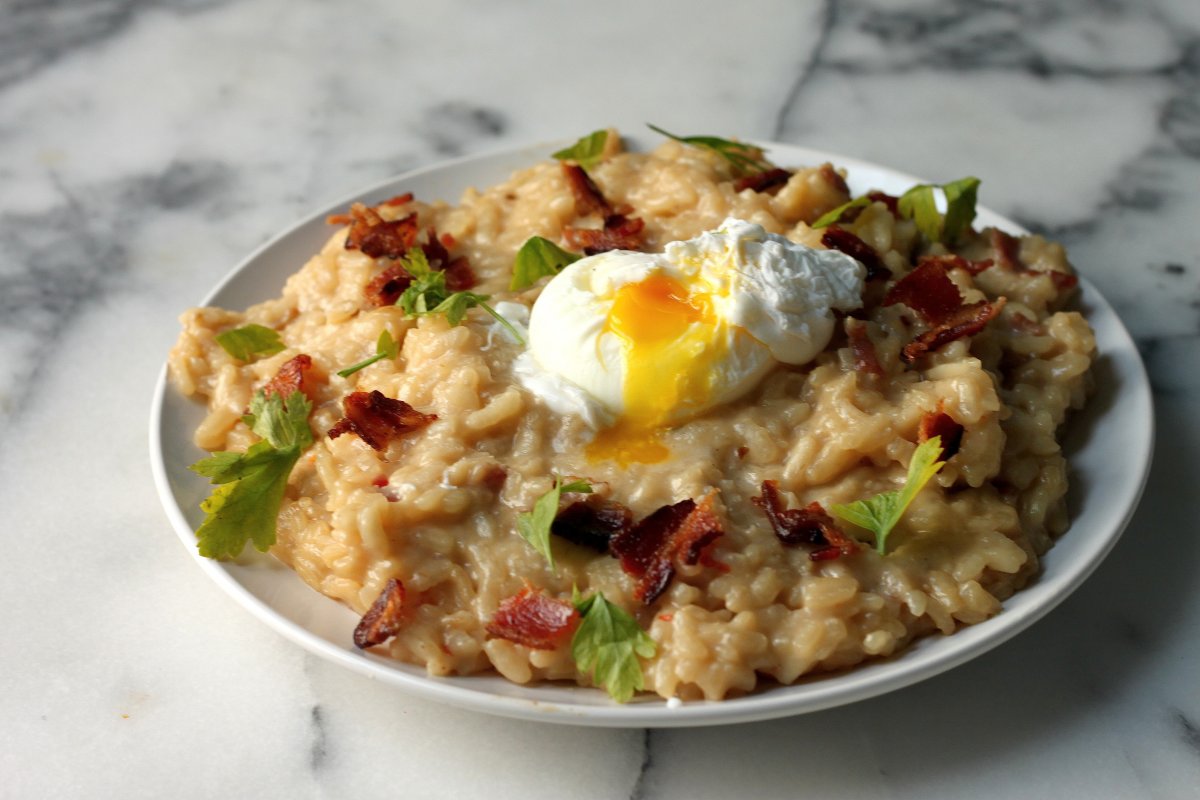
Like last week, this week’s recipe uses mushrooms; but here the much less costly button-style.  It’s risotto that can be breakfast, lunch or dinner.  It’s not fast, and has to be tended.  All of the components are relatively cheap and just need flavor to be teased from them.

Bacon and egg risotto

b&e risotto

3 slices bacon cut into ¾ inch strips

1 pound button mushrooms, cleaned and sliced

1 large shallot, diced

3 garlic cloves, minced

2 cups Arborio rice

½  cup Marsala wine

4 ½ cups chicken stock (approx)

12 ounces frozen peas

¼ cup parmesan cheese

3 tablespoons butter, divided

Salt and pepper to taste

6 eggs

1 tablespoon vinegar

Put stock into saucepan, and set to medium-low.  (You only want stock to simmer; turn down if it starts to boil.)

Put bacon into other saucepan, and render on medium-low until it is brown and crispy.  Remove from pan and set aside.

Pour off the bacon grease until you only have about 1-2 tablespoons in the pot.  Add mushrooms and season.  Sautee until the moisture has released and cooked out.  Add shallot and cook until the veg starts to brown around the edges.

Stir in risotto, garlic and one tablespoon butter.  Cook until the rice starts to brown just a bit.

Pour in Marsala, and cook until it’s completely absorbed.

While the wine is cooking out, put a shallow bottom pan on the stove, fill with water, and add vinegar.  Turn on medium and bring to very gentle simmer.

Constantly stirring, add about 1/2 cup of hot stock to rice pot until the liquid is absorbed, then add more.  After about 3 cups stock, start tasting for doneness and seasoning.

At this point, start poaching eggs, 3 at a time for about 4 minutes.  Remove from water with slotted spoon, and place on a plate covered with a clean kitchen towel to dry.

When the rice is cooked through, add peas, butter and cheese.  Gently stir until butter is melted.

Place about 1 1/2 cups risotto on plate and put 2 poached eggs on top.  Garnish with crispy bacon.  Serves 3.I won’t try to sugar-coat this for you.  It takes a good hour start to finish.

But done correctly you will have a trendy restaurant dish that patrons pay big bucks for.

Because even though money can’t buy time, some people will still try to charge for it.time_is_money-wallpaper-800x600Thanks for your time.

Meat popcorn

Better than French fries?Yup.

Better than beer-battered onion rings?

Uh huh.

Better than fresh, hot, homemade hushpuppies?You know it, dude.

It sounds crazy, and hard to believe, but last night I made something that took no time at all, and was crispy, salty, a little fatty, and completely, unrepentantly addictive.

It was deep fried steak.

I know, what the what?  But hear me out. The beef was flap meat.  It comes from a bottom sirloin butt cut.  It’s very, very thin.  Normally you sear or grill it in literally seconds; then slice it against the grain.  It’s delicious, and can be eaten as is or used for sandwiches, tacos, fajitas or salads.

Not much to look at in this state; but what a personality.

I’ve written about it before.  It’s an unsung carnivore’s hero, and the Matthews family could eat it every night (or breakfast) of the week.


I decided to use it in Asian-style rice noodles and vegetables.  But I’d never made authentic Chinese food from scratch.  This would be a complete first.

Fortunately, The Kid practically minored in Asian at culinary school, so I had a very handy resource.

At Whole Foods, I picked up rice noodles (I used half a 12 ounce box), broccoli (one large crown), shitake mushrooms (about four ounces), a small piece of ginger, and went home to experiment.

rice noodlesAs tasty as the flap steak is, it’s better when grilling or cooking the meat in a skillet that it is cooked no more than medium-rare.

But stir-fry cooking, which is how I planned to do the meal, is not really conducive to crusty, well-seared, medium-rare beef.  So cooking it, keeping it separate from the rest of the dish, and plating it on top of the noodles, almost like a garnish, was the plan.

Since the meal was Asian-inspired, I decided to try a technique that was new to me.  I sliced the meat into thin strips.  I didn’t pre-season it because there was soy in the sauce, which is quite salty.I took a small, straight-sided skillet and poured in about 1 ½ inches of vegetable oil.  I turned on the burner to get it up to 350 degrees.While it was heating, I put ½ cup or so of cornstarch on top of the meat (about 1 pound), covered the bowl, and shook it vigorously to coat all the meat evenly.  You want to do this right before cooking, so that it doesn’t absorb too much cornstarch, which will make it gummy.

I took a small, straight-sided skillet and poured in about 1 ½ inches of vegetable oil.  I turned on the burner to get it up to 350 degrees.  While it was heating, I put ½ cup or so of cornstarch on top of the meat (about 1 pound), covered the bowl, and shook it vigorously to coat all the meat evenly.  You want to do this right before cooking, so that it doesn’t absorb too much cornstarch, which will make it gummy.

When the oil came up to temp, I dropped in one third of the meat and gave it a very gentle stir.  In 20-30 seconds, I removed it with a slotted spoon onto a paper-towel covered plate.  At this point, I gave it a little sprinkle of kosher salt, like you would French fries.This stuff was amazing.  It was crispy on the outside, tender inside, and supernaturally amazing.  I could truly eat this stuff by the handful.  But I set it aside and finished dinner.
When stir frying, everything must be ready to go when you start cooking.  Once it starts, it moves very fast, and you must be prepared.  The rice noodles get pre-cooked, the broccoli blanched, and all the veggies need to be prepped.  My aromatics were three cloves of garlic, ½ teaspoon grated ginger and one large shallot, diced.

I turned on my Dutch oven medium-high, and added about a tablespoon of vegetable oil.  Then I put in the aromatics and cooked them, stirring constantly.  When they were hot and fragrant, I added the mushrooms and cooked them until they were softened.  The broccoli came next and cooked until hot, and finally the noodles.  I then poured in my sauce.

Stir fry sauce

stir fry sauce

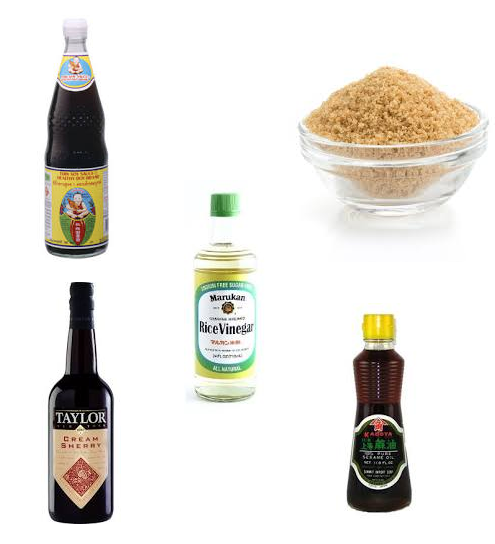
1/4 cup soy sauce

1 1/2 teaspoons brown sugar

2 tablespoon rice wine or red wine vinegar

2 tablespoons sherry

1 teaspoon toasted sesame oil

I tossed, and when everything was well coated, I plated, adding the flap steak on top.

It turned out really well.  As usual, I made too much for just Petey and me, so we have leftovers.  But they are vegetarian, ‘cause that meat is profoundly gone.

Thanks for your time.

Don’t hide your ‘shrooms under a bushel

I have no idea how I lucked out, but I did.

Normally chanterelle mushrooms sell for about thirty dollars a pound.  Consequently, I’ve never had the pleasure of their company in my kitchen.

But a while back I was in Whole Foods.  I don’t whether it was a mistake, there was a glut on the market, or it was a straight-up holiday miracle, but those puppies were selling for $4.99 a pound.  I filled a bag, and skipped all the way home.  The whole time I expected someone to grab me because there’d been some type of grievous mushroom error.

Nope, I made it back to Chez Matthews, chanterelles in hand.

I then pondered preparation.

Spinach salad: one of my favorite recipes with mushrooms.

We eat mushrooms a few times a week, in all kind of dishes.  But I didn’t want to dim their star power one bit.  It would be like having Aretha Franklin over only to ask her to sing “Happy Birthday”.

So they would not languish in gravy, or meatloaf, or soup.  I wanted my windfall to b.e the star.

About the same time I was in Lowes Foods and bought a bag of completely adorable cherubic red skinned potatoes.  They were literally the size of a shooter used in a game of marbles.  Actually they’re known as marble potatoes.

To celebrate these two delightful, earthy treasures, I decided to do a simple roasting.  This would keep them close to their natural state.  I wouldn’t try to manipulate the flavors either, but just bring out the very best of them that I could.

If you don’t happen to luck out and find some fresh chanterelles that you can afford without a second mortgage, any type of mushroom can be used.

Oven-roasted chanterelles and potatoes

roasted chanterelles

1 ½ pounds (approx) marble or grape-sized potatoes, washed, but left unpeeled

1 ¼ pounds (approx) chanterelles or other wild mushrooms, washed and cut into bite-sized pieces.

¼ cup vegetable oil

1 ½ teaspoons salt

1 teaspoon pepper

Place a large pan into oven and preheat to 450 degrees.

Place potatoes and mushrooms into a large bowl, and drizzle with oil.  Season with salt and pepper and toss to coat.

When the pan and oven are up to temp, pour vegetables onto pan into one even layer.  Bake for about 30 minutes, or until potatoes are tender, and mushrooms are brown and crispy around the edges, stirring every 10 minutes.

Serves 4-6.

Although The Kid might strenuously disagree with this statement, I usually don’t like to lecture.  But in this case, I feel that I must make a point.

I’m not sure that we always remember how fortunate we are as Americans.  The quantity and quality of our choices with which to stock our pantries is almost obscene.  Within thirty minutes of my house there are probably fifty different places to shop for our dinner.  The only limits are money and imagination.

Even if I am cooking something as common and prosaic as hamburger, tomatoes or egg noodles, I feel the need to honor the food.  To treat each ingredient as lovingly and skillfully as I am able.  Not only am I paying basic respect to the cow, farmer, or noodle maker, the flavors that result will reflect the care I have taken.

Heavy sauces and complicated cooking procedures originally became popular to hide wonky, and even rancid food.

But because of the plethora of choices, and superlative quality the best thing we can do is to get out of our food’s way and let it shine.

Thanks for your time.